
Federal Tax Credits for Panels and EV Chargers Are Ending
November 1, 2025
California’s New Electrical Code: What Homeowners Should Know
January 1, 2026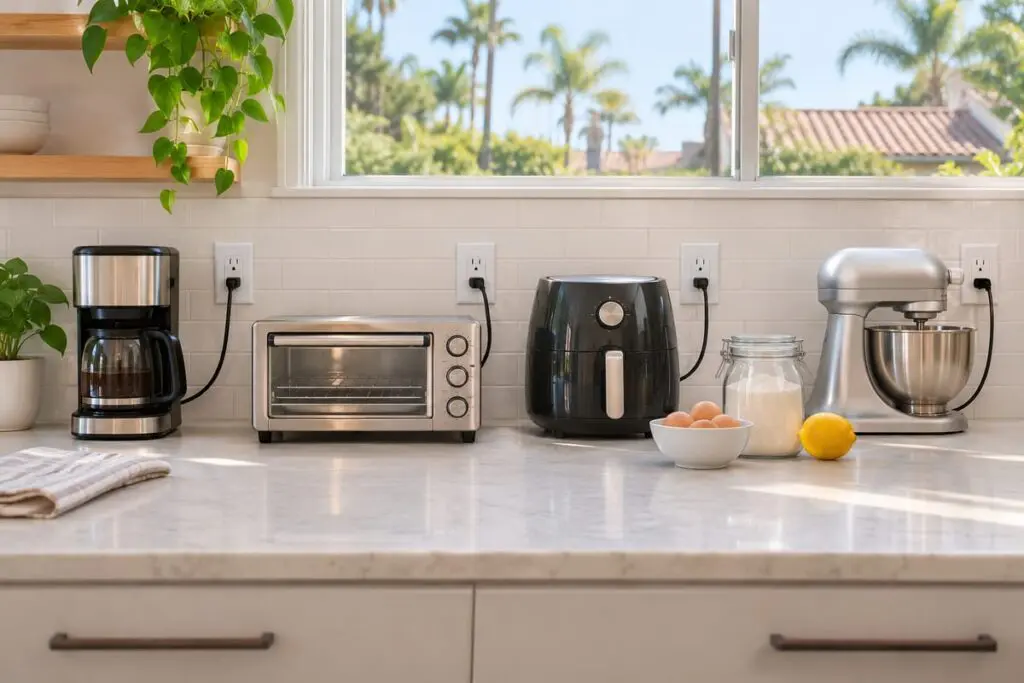
Which appliances need a dedicated circuit in your kitchen?
Built-in appliances get their own circuit: your electric range or wall oven, dishwasher, garbage disposal, a built-in or over-the-range microwave and, ideally, your refrigerator. Countertop appliances share your kitchen’s countertop circuits. That sharing is why the breaker trips when the air fryer and the coffee maker run at the same time.
If that happened to you mid-Thanksgiving, with the gravy half done, you’re in good company. With the December holidays a few weeks out, here’s which appliances need a dedicated circuit (one appliance, fed by its own breaker) and which are fighting over the same wire.
The built-in appliances that should have their own breaker
Built-ins are wired in place, and code or the manufacturer’s installation instructions usually give each one a circuit of its own:
| Appliance | Typical circuit |
|---|---|
| Electric range, cooktop or wall oven | Its own 240-volt circuit, commonly 30 to 50 amps depending on the appliance |
| Dishwasher | Its own circuit |
| Garbage disposal | Its own circuit |
| Built-in or over-the-range microwave | Its own 120-volt, 20-amp circuit |
| Refrigerator | Its own circuit recommended, not always required |
These are typical setups. Your appliance’s installation instructions are the final word. Outside the kitchen, the same goes for your washer, dryer, water heater, furnace, air conditioner and EV charger.
Why two countertop appliances trip a shared circuit
Countertop appliances that make heat are the heavy hitters. An air fryer, toaster oven, coffee maker, electric kettle, pressure cooker, griddle or roaster oven each draws roughly 1,000 to 1,800 watts.
Now the math. A 20-amp circuit carries 2,400 watts. Say your air fryer pulls 1,500 watts and your coffee maker 1,000. Together that’s 2,500, and the breaker does exactly what it’s built to do. On an older 15-amp circuit, which carries 1,800 watts, one big appliance plus almost anything else can trip it. (It’s the same arithmetic behind a space heater that keeps tripping the breaker.)
Code requires at least two 20-amp circuits for kitchen countertop outlets. Plenty of older kitchens have just one, sometimes shared with the dining room, so every holiday dish draws from the same 2,400 watts.
How to cook through the December holidays without a trip
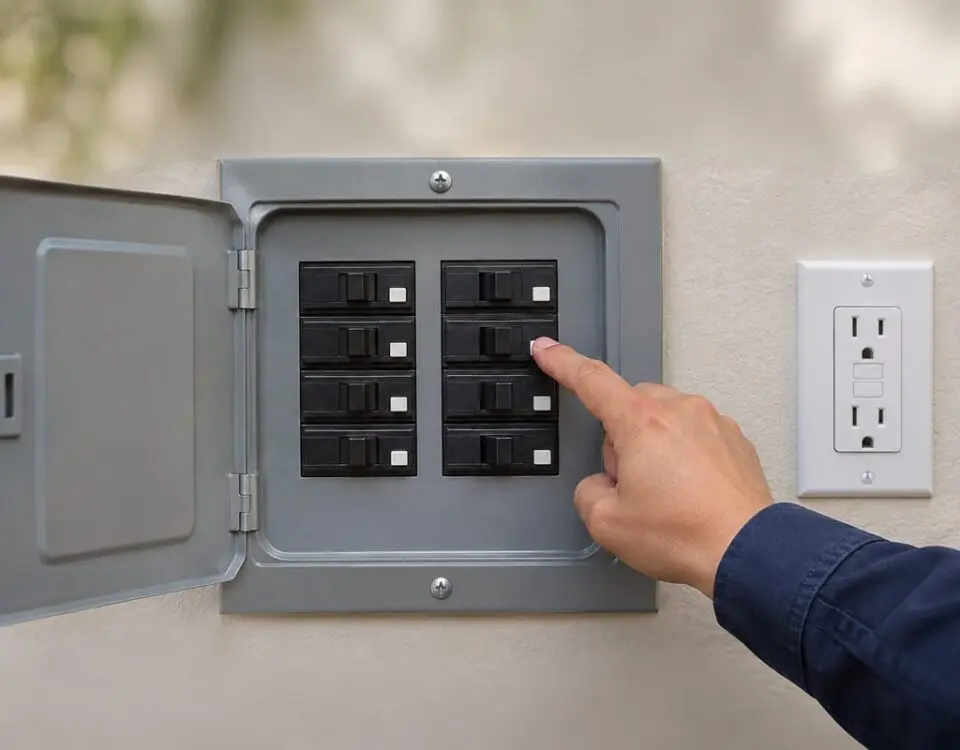
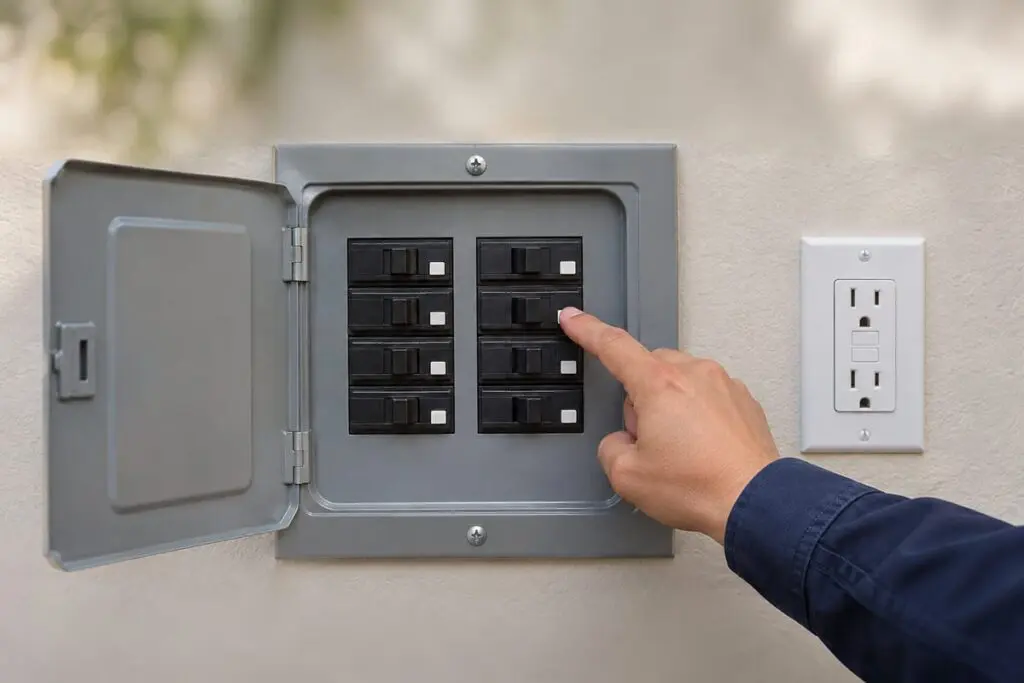
- Find out which outlets share a breaker. Turn one kitchen breaker off and check which outlets go dead. Jot it down, then turn the breaker back on.
- Stagger the heating appliances. Brew the coffee, then start the air fryer. Not both at once on the same circuit.
- Move the roaster oven. Plug it into an outlet on a different circuit from your other cooking appliances.
- Skip extension cords and power strips. They don’t add capacity, and they can overheat.
If a breaker does trip, unplug something and reset it once.
When the trips point to something worse than an overload
These signs aren’t simple math:
- An outlet or cover plate that feels warm
- Scorch marks around an outlet
- A breaker that trips with one small appliance running
- Lights that dim when something starts
Stop using that outlet and book electrical troubleshooting with a licensed electrician. If you smell burning or see smoke, get everyone out and call the fire department first.
The lasting fix: more kitchen circuits
If your kitchen trips every time you cook for a crowd, the real cure is another circuit: an extra countertop circuit, or a dedicated outlet for your microwave. Either one needs open space in your panel. If yours is full, a subpanel can add room; an electrical panel check tells you which. Planning a remodel? Do it then, while the walls are open.
Infiniti Electric is licensed, insured and bonded, and we do this work with permits. If your breaker keeps winning the holiday cooking battle, contact us and we’ll sort out what your kitchen actually needs.
Kitchen circuit questions we hear around the holidays
Does a refrigerator need its own circuit?
Not always, but it’s a good idea. On its own circuit, a countertop trip can’t quietly shut off your fridge while you’re out of the kitchen.
Can a microwave and a toaster oven share a circuit?
Only if you don’t run them at the same time. Both are big draws, and together they can easily top the 2,400 watts a 20-amp circuit carries.
How many circuits should a kitchen have?
At least two 20-amp countertop circuits, plus one for each built-in, such as your range, dishwasher, disposal and built-in microwave. If you cook a lot, a third countertop circuit is money well spent.
Do I need a bigger panel to add kitchen circuits?
Usually not. You need open breaker spaces, or a subpanel if your panel is full. An electrician can check whether your home’s total load calls for anything more.