
Does an ADU Need Its Own Electrical Panel or Meter?
August 1, 2026
GFCI vs. AFCI: What’s the Difference?
October 1, 2026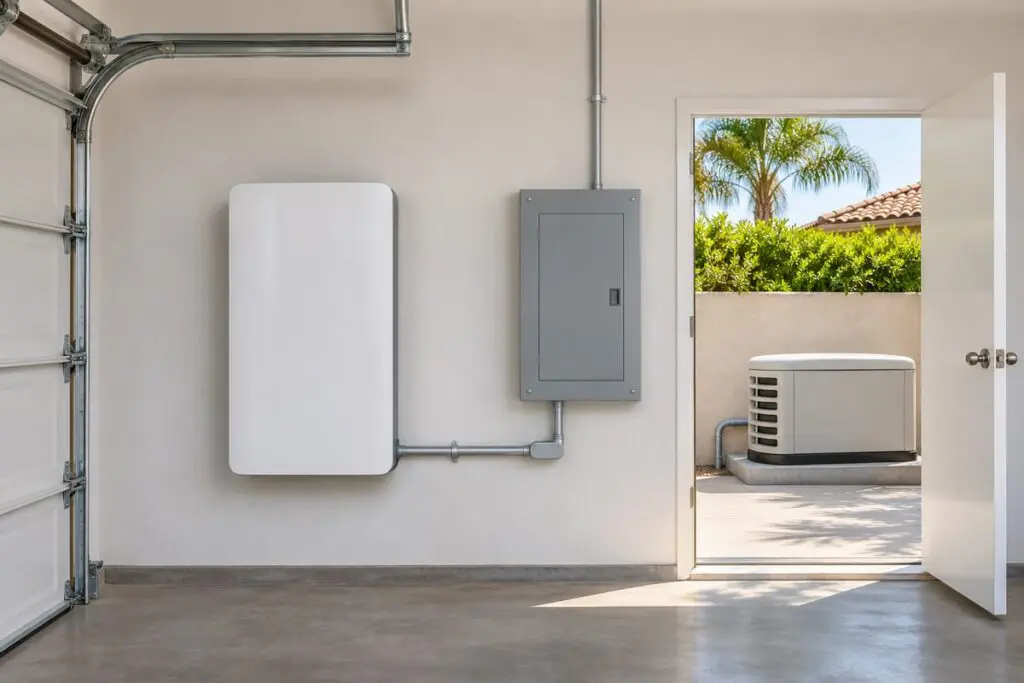
Generator vs battery backup: which one should you choose?
Choose a standby generator if your outages can last days or you need central air through them. It runs as long as fuel flows and handles big loads. Choose a home battery if you want silent, instant backup for essentials, especially if you have solar panels that can recharge it. How long your outages last decides it.
September is a good month to settle this. Fall wind season is coming, and backup power takes time to permit and install. You want it working before the first outage, not ordered after it. (If you’re expecting a planned shutoff, our post on preparing your home for a Public Safety Power Shutoff covers the short-term steps.)
Generator vs battery at a glance
| Standby generator | Home battery | |
|---|---|---|
| Runtime | As long as natural gas or propane flows | About 10 to 15 kWh per battery, then it needs recharging |
| What it can run | A whole house, including central air (common units are 14 to 26 kW) | Essentials for many hours; central air drains it in a few |
| Noise | Audible while running | Silent |
| Maintenance | Oil changes and a weekly self-test run | Very little |
| Works with solar | No | Yes, it can recharge from your panels |
Runtime and air conditioning decide most cases
Say the power goes out on a hot afternoon and stays out until the next evening. A generator sized for the house starts by itself within seconds through an automatic transfer switch, and your AC keeps running all night. Nothing to babysit. It just needs a gas supply big enough to feed it.
Now run the same outage on a single battery. Your refrigerator, lights, internet and a few outlets can coast for many hours on 10 to 15 kilowatt-hours. Turn on central air, though, and that same battery can be empty in a few hours. Without solar, a drained battery stays drained until the grid comes back.
Solar changes the math. Panels can refill the battery during the day, which can stretch your backup across a multi-day outage when the weather is sunny. Not a guarantee. A good bet in Southern California, though.
There’s a second limit people miss: power, not just storage. A battery can only run so much at once, and it may not be able to start a large motor. More batteries raise both the storage and the power limit. Our guide to what size generator you need for your house walks through the same kind of load math for generators.
Living with each one
A generator makes noise when it runs, including that weekly self-test. It needs clearance from windows and doors, and it needs regular oil changes. A battery mounts on a wall and mostly asks to be left alone.
What installation involves
Both options need electrical work at your electrical panel, and both need permits:
- Generator: transfer equipment that keeps generator power off the utility lines, plus a gas line sized for the unit.
- Battery: a backup gateway and often a critical-loads subpanel that holds the circuits the battery will carry.
- Battery placement: fire-code rules limit where a battery can be mounted.
Infiniti Electric is licensed and insured and handles backup generator installation for homes and businesses across Riverside and the Inland Empire. Tell us which loads you can’t live without, and how long your outages tend to run, and we’ll tell you which option fits. Contact us to start before wind season does.
Questions about generators and home batteries
Can I have both a generator and a battery?
Yes, and some homes do. The battery covers the first moments silently and handles short outages, while the generator takes over for the long ones.
Can a home battery start my central air conditioner?
Only if its power rating can handle the compressor’s startup surge. A single battery often can’t, and adding batteries raises that limit. Even when it starts, central air drains stored energy fast.
Does a home battery do anything when the power is on?
Yes. It works every day, storing energy and supplying it in the evening, so it isn’t sitting idle between outages. A generator only earns its keep when the grid goes down.