Why Does My AC Keep Tripping the Breaker?
August 1, 2024
Should You Replace a Federal Pacific or Zinsco Panel?
October 1, 2024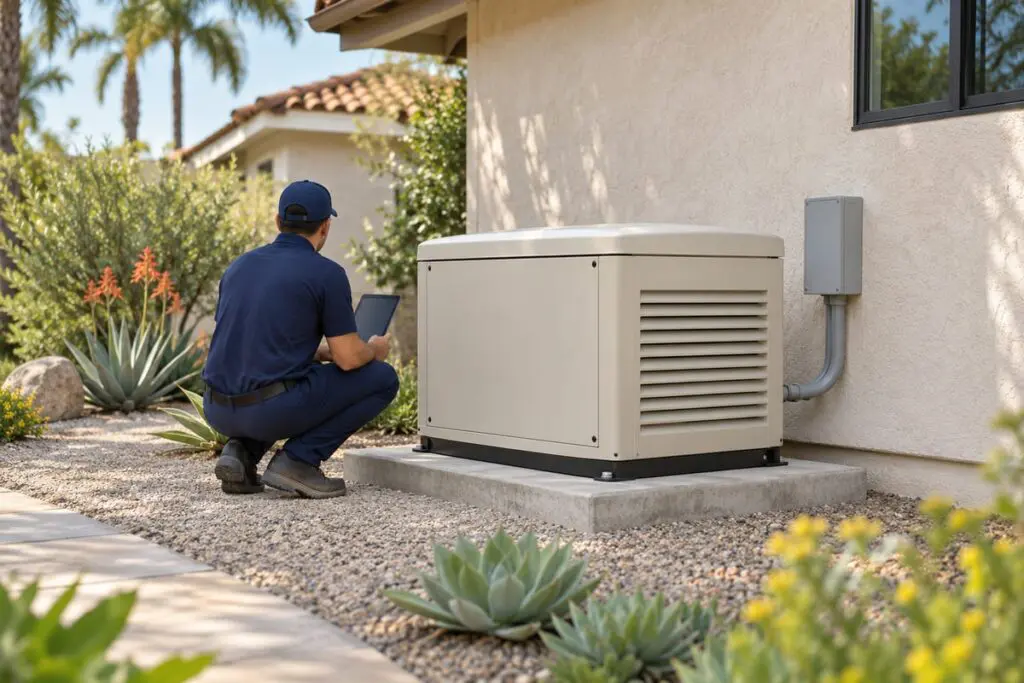
What size generator do I need for my house?
Size your generator to what you want running, not to your square footage. Add the running watts of everything you’d use at once, then add the biggest starting surge. Essentials fit on a portable of about 5,000 to 7,500 watts. Keeping central air on usually means a standby unit of roughly 14 kilowatts or more.
If last year’s outage is still fresh, you’re shopping at the right time. September leads into fall wind season across Southern California, and with the wind comes the risk of safety shutoffs. Those spec sheets full of wattage numbers make more sense once you know what you’re adding up.
Decide about central air first
One question splits this whole decision in two: do you need to stay cool during an outage? Central air is the biggest motor in most Inland Empire homes, and a portable generator generally can’t start it alongside everything else. Say yes to air conditioning and you’re shopping for a standby unit. Say no and a portable may cover you.
| What you keep running | Typical generator |
|---|---|
| Essentials: refrigerator, some lights, internet, phone charging, a gas furnace fan | Portable, about 5,000 to 7,500 watts |
| Most of the house, with big loads like the AC and dryer taking turns | Standby, roughly 14 to 18 kilowatts |
| Everything at once, including central air and electric cooking | Standby, often 22 kilowatts or more |
These are ranges, and your own appliances decide where you land.
How to add up your watts
Every appliance has two numbers worth knowing. Running watts are what it uses once it’s going. Starting watts are the short surge a motor needs to get moving, and that surge is often two to three times the running number. Your refrigerator, your AC and any pump all surge when they kick on.
- List what you want backed up. Be honest about cooling, cooking, medical equipment and the home office.
- Read each nameplate. If the label shows amps instead of watts, multiply amps by volts. Say your fridge label reads 6 amps at 120 volts: that’s 720 running watts.
- Add the running watts of everything that might be on at the same time.
- Add the single largest starting surge on your list. You need room for the biggest one on top of your running total.
That total is the floor. Your generator has to cover it.
Connect it safely, or don’t connect it at all
A generator wired to your house needs a transfer switch, or a listed interlock kit with a power inlet. Either one keeps generator power off the utility lines. Without it, power can backfeed onto the street, where it can injure line workers, and it wrecks the generator when utility power comes back.
Standby units use an automatic transfer switch and run on natural gas or propane. They need clearance from windows and doors, and your gas meter has to be big enough to supply one. Your electrical panel also has to accept the transfer equipment. Infiniti Electric is licensed and insured, and our backup generator work covers the sizing, the transfer switch and the install.
One rule for portables: never run one in a garage or near an open window. Carbon monoxide builds up fast and it kills.
Pick your size before the winds pick up
Generator installs take time to permit and schedule, so the calm weeks before wind season are the easy time to plan. Reach out to us with the list of things you want running, and we’ll help you work out the size that fits.
Generator sizing questions homeowners ask
Is a bigger generator always better?
No. An oversized generator costs more up front and burns more fuel when it’s lightly loaded. Size it to the loads you’ll actually run plus about 20 percent of headroom.
Do I need a permit for a standby generator?
Yes. A standby unit involves permanent electrical and gas work, so plan on a permit and an inspection before it goes into service.
Can a load-management module let me buy a smaller generator?
Often, yes. The module sheds big appliances automatically when the generator nears its limit, so your AC and dryer take turns instead of running together. That can let a smaller standby unit handle the whole house.