
What Is a Subpanel, and When Do You Need One?
June 1, 2026
Does an ADU Need Its Own Electrical Panel or Meter?
August 1, 2026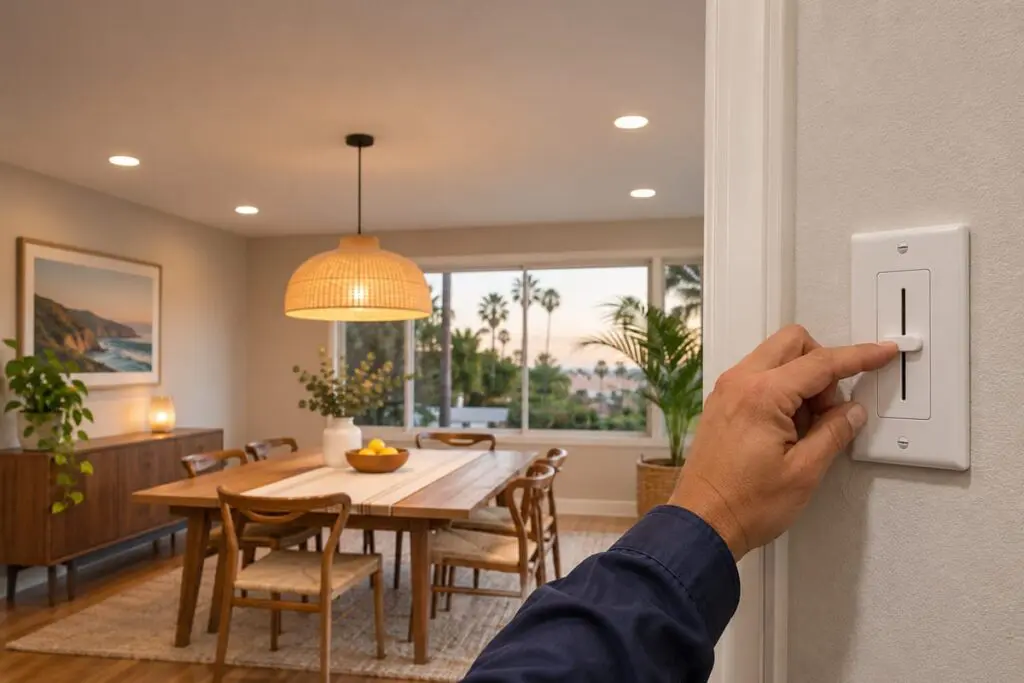
Why do LED lights flicker on a dimmer?
Almost always, it’s the dimmer. Older dimmers were built for incandescent bulbs and need a minimum load, often 40 to 60 watts, to work properly. A handful of LED bulbs can total less than that, so the dimmer can’t control them smoothly. You get LED lights flickering on a dimmer, buzzing, or glowing when they should be off.
Here’s how it usually goes. You swap the dining room bulbs for LEDs, flip the switch, and everything looks fine at full brightness. Then you slide the dimmer down for dinner and the lights start to stutter. Your bulbs aren’t broken and your wiring is probably fine. The dimmer on your wall was designed for bulbs that drew far more power than these do.
Signs your dimmer and bulbs don’t match
- flicker, especially at lower settings
- a buzz from the bulbs or the dimmer
- lights that drop out at the low end of the slider
- lights that stay off, then pop on suddenly as you raise the dimmer
- a faint glow when the dimmer is off
How to fix LED flicker on a dimmer, in order
- Check that your bulbs say “dimmable.” Not every LED is. The package tells you. A non-dimmable LED on a dimmer flickers and tends to fail early.
- Use the same bulb model in every socket on that dimmer. Mixing brands, or even two versions of one brand, gives the dimmer bulbs that behave differently at the same setting.
- Replace the dimmer with one rated for LEDs. This is usually the fix. Swapping a dimmer means working with switch wiring, so have an electrician do it.
- Set the new dimmer’s low-end trim. Many LED dimmers have a small dial or lever that sets the minimum brightness. Raise it until the flicker at the bottom disappears.
- Check the compatibility list. Bulb and dimmer makers publish lists of pairings they’ve tested. If yours isn’t on it, that may be your answer.
One thing catches people off guard: a dimmer’s wattage rating is far lower for LEDs than for incandescent bulbs. A dimmer marked 600 watts incandescent is typically rated for around 150 watts of LED. Read both numbers before you load up a big chandelier.
Low-voltage lights and smart bulbs play by different rules
Low-voltage lighting, like small spot bulbs and some under-cabinet and landscape lights, runs through a transformer. That kind of lighting needs a dimmer type matched to its transformer, and a regular LED dimmer may not be it.
Smart bulbs shouldn’t be on a dimmer at all. Leave the wall switch at full on and dim them from the app. If you’d rather have dimming at the wall, a smart switch or dimmer is the better route.
When the dimmer isn’t the problem
Some flicker has nothing to do with your dimmer. Call an electrician if:
- lights on plain on/off switches flicker too
- the whole house flickers
- it happens when your AC or another big appliance starts (our post on lights that dim when the AC turns on explains why)
- the dimmer is hot, crackles or smells
Those point to a wiring or connection problem. If a dimmer is hot or crackling, turn off its breaker and leave it off. If you smell burning or see smoke, get out and call the fire department first.
Getting your lights to dim smoothly
Infiniti Electric is a licensed, insured electrician available 24/7 for homes and businesses around Riverside and the Inland Empire. We can match dimmers to your bulbs as part of our lighting work, or track down flicker that a new dimmer won’t fix. Reach out and tell us what your lights are doing.
LED dimmer questions we hear often
Why do my LED lights glow when the switch is off?
Usually because your dimmer lets a trickle of current through even when it’s off, and an LED needs very little to glow. An LED-rated dimmer typically stops it.
Why does my dimmer buzz?
A buzz from the dimmer or bulbs is a common sign of a dimmer and LED mismatch. Matching the bulbs and using an LED-rated dimmer usually quiets it, but a buzz that comes with heat or crackling needs an electrician.
Is a warm dimmer switch dangerous?
No, a slightly warm dimmer is normal, because it sheds a little heat while it works. One that’s hot to the touch isn’t normal, so turn off its breaker and have it checked.