GFCI vs. AFCI: What’s the Difference?
October 1, 2026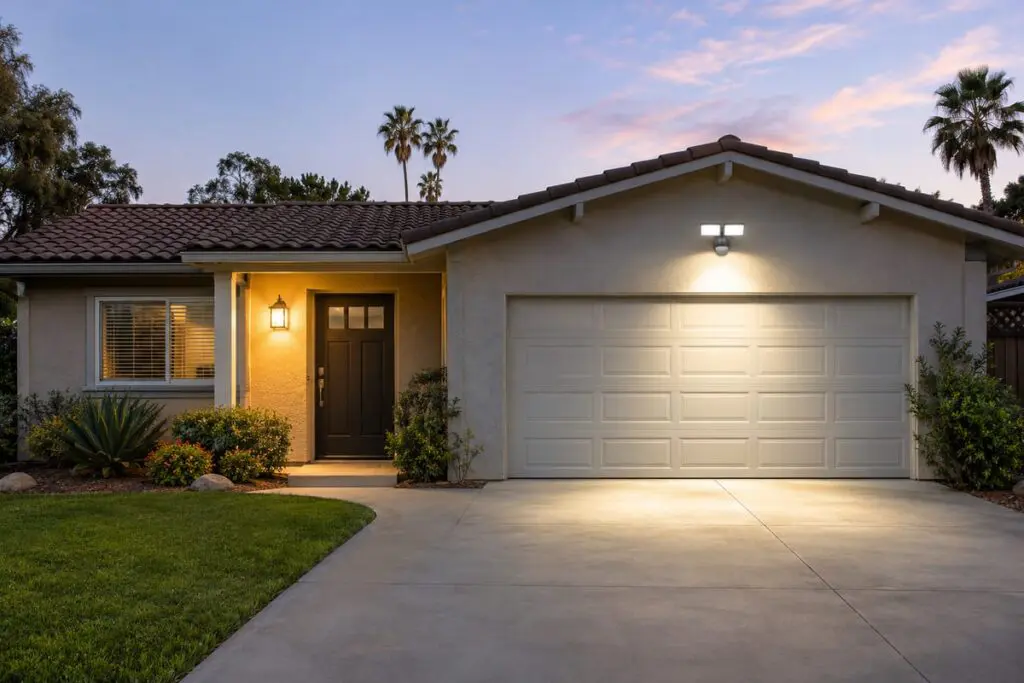
Motion sensor or dusk-to-dawn lights: which should you pick?
You don’t have to pick one for the whole house. Use dusk-to-dawn lights where people need to see, like your front door, steps and paths. Use motion-sensor lights where you want to know something moved, like your driveway and side yard. And a dual-level fixture does both: dim all night, bright on motion.
Daylight saving time ended at 2 a.m. this morning. Starting tonight, it gets dark before most people are home, and you’ll be pulling into your driveway at 5:30 with no light to see by. If your old floodlight is either always off or always on, now is the time to fix it.
Motion sensor vs dusk-to-dawn lights at a glance
| Dusk-to-dawn | Motion sensor | |
|---|---|---|
| How it turns on | A photocell switches it on at sunset and off at sunrise | Detects movement and heat, then times out |
| Best spots | Front door, house numbers, steps, paths | Driveway, side yards, backyard, garage |
| Security cameras | Steady light all night | Dark between triggers |
| Main drawback | Light spilling into bedrooms and onto neighbors | False triggers |
Where dusk-to-dawn lights make sense
A guest pulls up to your house at night, looking for the number. A steady porch light answers before they even get out of the car. That’s the job dusk-to-dawn lights do best: low, constant light where people walk, plus clean coverage for your cameras.
The common complaint is glare. A bare bulb burning all night shines into your bedroom and your neighbor’s window. Choose shielded fixtures that aim the light down, and pick a warm color. You’ll still see the steps, and nobody will be squinting at your house.
Where motion-sensor lights earn their place
Motion lights are an alarm you can see. When someone walks up your side yard and the light snaps on, it startles them and tells you something moved. That makes them a good fit for driveways, backyards and the side of your garage.
The tradeoff is darkness between triggers, which is hard on security cameras. They also fire at things you don’t care about. Placement fixes a lot of it:
- Mount the sensor about 6 to 10 feet up.
- Aim it so people walk across its view, not straight toward it. Sensors pick up side-to-side movement more easily.
- Set the range, sensitivity and on-time. Most fixtures have adjustments for all of them.
The fixture that does both, and controls that don’t need resetting
A dual-level fixture stays dim all night and jumps to full brightness when it senses motion. Your front walk is never dark, and you still get the alert. For a lot of homes, that’s the best single answer.
If your outdoor lights run on a plain timer, it’s now an hour off. Smart controls and astronomical timers follow sunset automatically, so there’s nothing to reset when the clocks change. Our smart system installs can tie outdoor lights into the rest of your home. California’s energy code generally requires automatic controls, such as a photocell with a motion sensor or timer, or an astronomical time clock, on new outdoor lighting attached to a home.
What the electrical work looks like
Outdoor fixtures and boxes have to be rated for wet locations. Adding a light where there’s no wiring means a new cable run and a switch. If you already have a fixture in the right spot, the job is usually simpler. Infiniti Electric is licensed and insured and handles outdoor lighting for homes and businesses across Riverside. Contact us and tell us which spots stay dark.
Outdoor lighting questions for the dark months
Do motion lights use less electricity than dusk-to-dawn lights?
Yes, because they’re off most of the night. With LEDs the difference is small, though: a 10-watt LED running 12 hours a night uses about 44 kilowatt-hours a year.
Why does my motion light turn on by itself?
Something is triggering it, usually plants moving in the wind, pets, passing cars or a heat source in the sensor’s view. Lower the sensitivity or shorten the range, and re-aim the sensor away from the street and the shrubs.
Can I add a motion sensor to an existing light?
Yes, often. An existing light can usually be converted with a new motion fixture or an add-on sensor, without running new wiring.