
Hardwired Smoke Detector Chirping? What to Do
March 1, 2025
Can You Replace a Light Fixture With a Ceiling Fan?
May 1, 2025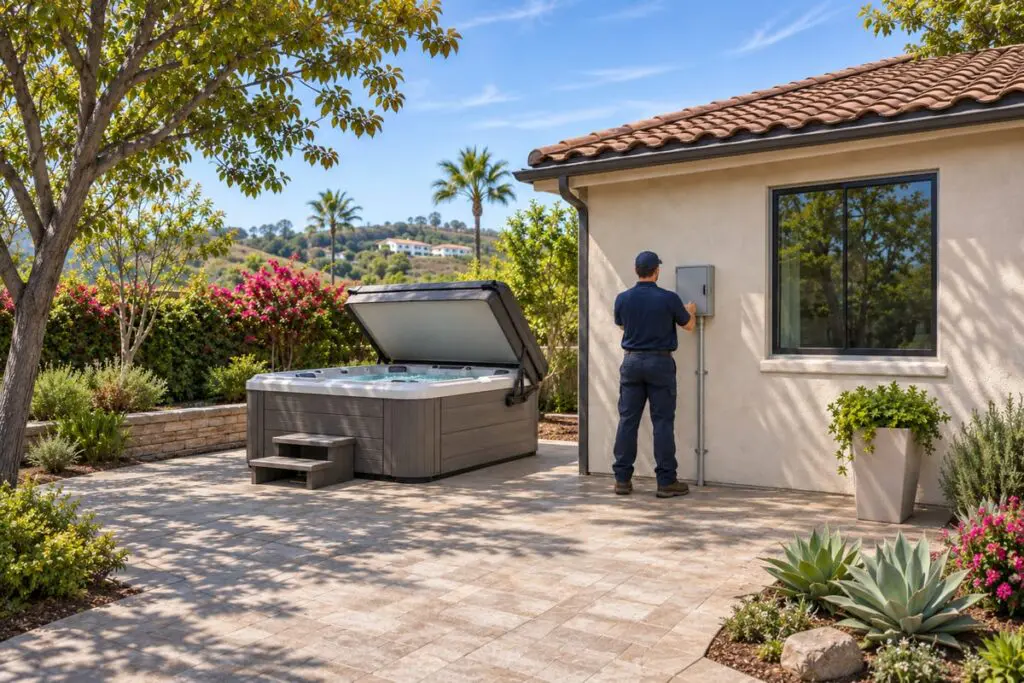
What are the electrical requirements for a hot tub?
Most full-size hot tubs need a dedicated 240-volt circuit, commonly 50 amps, hardwired through a GFCI-protected spa panel that doubles as the disconnect. That panel sits within sight of the tub and at least 5 feet from the water. The wiring runs in conduit, and the job needs a permit and an inspection.
Just found out your dealer’s price stops at the tub itself? You’re in good company. A hot tub is one of the biggest electrical loads you’ll ever add to your house, and where you put it decides most of what the wiring costs.
Start with your hot tub’s manual
Hot tubs range from about 30 to 60 amps. Your manual lists the exact breaker and wire size for your model, and that’s what your electrician builds to and what the inspector checks against. Send a copy to whoever’s quoting the job.
Smaller “plug-and-play” tubs run on 120 volts from a dedicated, GFCI-protected outlet. The catch: they heat slowly, and most can’t run the heater and the jets on high together. And no extension cords. Not even for the first weekend.
What a 240-volt hookup includes
- A dedicated circuit. The tub gets its own breaker and wire. Borrowing your dryer circuit or your AC circuit is off the table.
- A spa panel. This small outdoor box holds a GFCI breaker that protects anyone in the water, and it’s also the disconnect that cuts power to the tub.
- Conduit and copper wire. Copper conductors and an insulated ground wire run in conduit. Buried runs have minimum depths, which is why trenching shows up on so many quotes.
- Bonding. The metal parts around the tub get tied together so there’s no voltage difference between them. You won’t see it when the job’s done, but the inspector will look for it.
Why keep the disconnect 5 feet away? Picture someone leaning out of the tub, soaking wet, to flip the switch. The code puts it out of reach on purpose, but close enough that you can still see the tub from it.
Pick the spot before you pour the pad
Say you’ve poured a pad in the far corner of the yard. Now the wire has to cross the whole yard, maybe under a walkway, and there’s a power line overhead. Each of those details changes the job. The electrical code limits outlets, light fixtures and overhead power lines near a tub, so have the location checked before the concrete goes down.
Your cost comes down to the distance from your main panel to the tub, whether the run means trenching dirt or cutting concrete, and how much room your panel has left.
Can your panel carry it?
A 50-amp, 240-volt circuit is a big draw, so the job starts with a load calculation. A full panel may need a subpanel. A small or older service may need an upgrade first. Our post on when to upgrade a 100-amp panel to 200 amps explains how to tell, and our pool and spa panel upgrades page covers the outdoor side.
The order the work happens in
April’s a good month to start if you want to be soaking by summer. The permit comes first, then get the circuit, conduit and spa panel in before delivery. Once the tub is set, your electrician makes the final connection. Only then does it get filled and powered up.
Infiniti Electric is a licensed and insured contractor in Riverside, and permits and inspections are part of our hot tub and spa hookups. Got a delivery date and a spot in mind? Contact our team and we’ll look at both before anything gets poured.
Hot tub wiring questions we hear a lot
Can I plug a full-size hot tub into a regular outdoor outlet?
No. A full-size 240-volt tub has to be hardwired on its own circuit, and only 120-volt plug-and-play models use an outlet, a dedicated GFCI one at that.
Do I need a permit to wire a hot tub in Riverside?
Yes. Hot tub wiring needs a permit and an inspection, and the inspector checks the work against your tub’s manual and the electrical code.
Can a 100-amp panel handle a hot tub?
Sometimes, and a load calculation is the only way to know. A smaller tub on a lightly loaded service may fit, while a 50-amp tub in a busy house may need a subpanel or a service upgrade.