Is a Whole-Home Surge Protector Worth It?
August 1, 2025
Generator Interlock Kit vs. Transfer Switch
October 1, 2025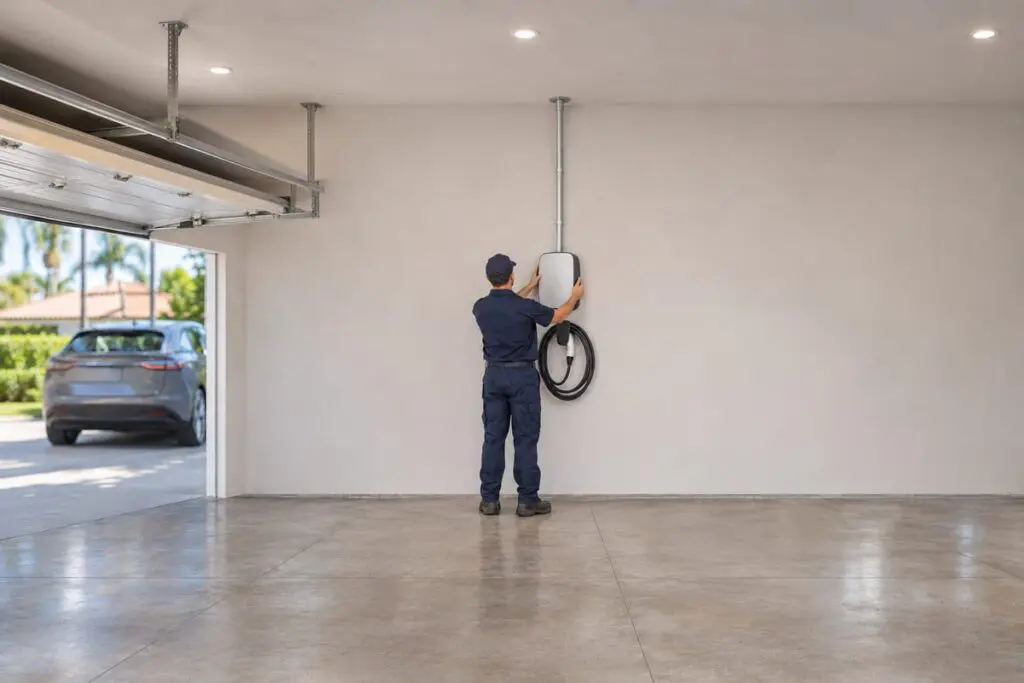
Hardwired vs. plug-in EV charger: which should you choose?
Hardwire it unless you have a specific reason not to. A hardwired charger can charge faster, has no outlet to overheat and avoids nuisance GFCI trips. A plug-in charger makes sense if you rent, plan to take the charger when you move, or already have a heavy-duty 240-volt outlet in the right spot.
You’ve picked a Level 2 charger (if you’re still deciding on that, start with our guide to Level 1 vs. Level 2 charging). Now the product page offers two versions of the same unit, one with a plug and one without. Here’s how they really differ.
Hardwired and plug-in chargers side by side
| Hardwired | Plug-in | |
|---|---|---|
| Max charging rate | 48 amps (about 11.5 kW) on a 60-amp circuit, if your car accepts it | 40 amps (about 9.6 kW) on a 50-amp circuit |
| GFCI breaker | None; relies on the charger’s built-in protection | Required on the outlet, which can cause nuisance trips |
| Outdoor use | Better: no plug or outlet for water to reach | Possible, but the outlet is exposed |
| Portability | Stays with the house | Unplug it and take it with you |
| Failure points | The charger itself | The charger, the plug and the outlet |
Why the outlet is the weak link
Most plug-in chargers use a NEMA 14-50 outlet, the same four-prong style you see at RV parks. Sounds simple. The catch is the kind of work you’re asking that outlet to do.
A dryer runs for an hour, then rests. An EV charger pulls high current for hours at a stretch, night after night. Electricians call that a continuous load, and it’s why the charger is held to 40 amps on a 50-amp circuit. Bargain residential-grade 14-50 outlets have overheated and melted under that duty. If you go plug-in, the outlet needs to be a heavy-duty, industrial-grade part, with the terminals tightened to the manufacturer’s specified torque. A loose terminal heats up a little more every night.
If you ever smell something hot or burning near your charger, stop charging and turn off its breaker. If there’s smoke, get out and call the fire department first.
The GFCI problem
Current code requires GFCI protection on the outlet that feeds a plug-in charger. The charger already has its own ground-fault protection, and the two can disagree. Say you plug in at 10 p.m. and wake up to a car that barely charged because the GFCI breaker tripped overnight. A hardwired charger relies on its built-in protection, so there’s no GFCI breaker to trip.
When a plug-in charger is the better fit
The plug-in version earns its place in a few situations:
- You rent, and your landlord will allow an outlet but not a wall-mounted charger.
- You expect to move and want the charger to come with you.
- You’d like a failed charger to be a simple swap instead of a service call.
- You want the outlet to do other jobs, like powering an RV or a welder.
Already have a suitable outlet? That can tip it, too, as long as an electrician confirms the outlet is heavy-duty and the circuit is right for the job.
What both installations need
Either way, the charger gets a dedicated circuit, a load calculation to confirm your electrical panel can carry it alongside everything else in your home, and a permit. The plug or the hardwired connection is the small part of the job. The circuit behind it is what keeps you safe.
Infiniti Electric is licensed and insured and installs EV chargers for homes and businesses in Riverside and across the Inland Empire. Tell us which charger you bought and where you park, and we’ll recommend the right connection. Contact us to get started.
Hardwired and plug-in EV charger questions
Can I use my dryer outlet to charge my EV?
Usually not. Most dryer circuits are 30 amps, which limits charging to 24 amps, and older three-prong dryer outlets have no ground. Sharing a circuit with your dryer also requires a device made for that purpose.
Should I unplug my plug-in charger every day?
No. Those outlets aren’t built for constant plugging and unplugging, so leave the charger plugged in and just disconnect the cable from your car.
Can I convert a plug-in charger to hardwired later?
Only if the manufacturer’s instructions allow it. Some models are built for both, and others aren’t, so check your charger’s manual before planning on it.