What to Do When Rain Gets Into an Outlet or Panel
February 1, 2026
What Affects the Cost of Installing a Home EV Charger?
April 1, 2026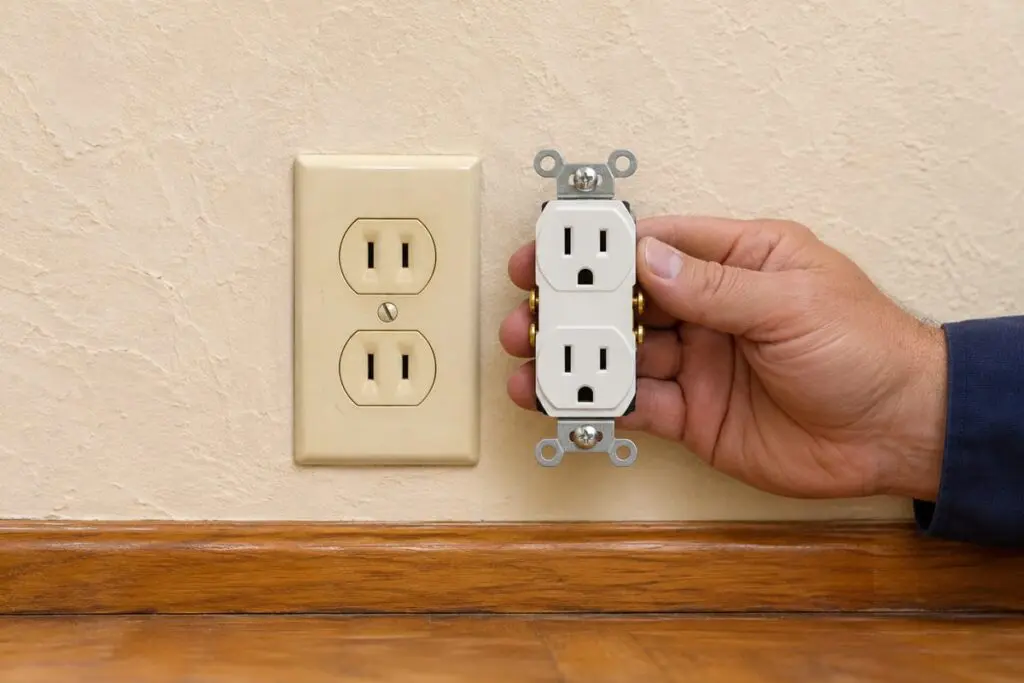
Can you replace a two-prong outlet with a three-prong outlet?
Yes, but not by swapping the outlet alone. A three-prong outlet on a circuit with no ground wire is a code violation. There are three approved ways to do it: run a ground to the outlet, install a GFCI outlet labeled “No Equipment Ground,” or protect three-prong outlets with a GFCI upstream and label them.
March kicks off spring house hunting, and in an older home this is often the first surprise. You unpack the vacuum and the microwave, and neither plug fits the wall.
Why a plain three-prong swap is a false promise
A two-prong outlet has no equipment ground, the extra wire that gives stray current a safe path back to your panel. Homes wired before the early 1960s commonly have them.
Put a three-prong outlet on that same circuit and nothing else, and the third hole connects to nothing. It looks grounded. Your surge protector and your computer think it’s grounded. It isn’t, and it’s a code violation.
The code-approved ways to get three-prong outlets
- Run a ground wire or new grounded cable to the outlet. This is the best fix, because you end up with a real ground.
- Replace it with a GFCI outlet labeled “No Equipment Ground.” You get a three-prong outlet that protects people from shock.
- Protect three-prong outlets with a GFCI upstream. One GFCI outlet or breaker covers the outlets after it on the circuit, and each one gets labeled “GFCI Protected” and “No Equipment Ground.”
You can also replace a worn two-prong outlet with a new two-prong outlet. Nothing wrong with that.
Sometimes there’s good news hiding in your wall. If your home was wired with metal conduit or armored cable, the metal box may already be grounded. An electrician can test it, and if it is, grounding the outlet is simple.
One more thing to plan for: current code may also require tamper-resistant and arc-fault protection when outlets are replaced. A licensed electrician doing outlet and GFCI installs will sort out which applies to each spot.
What a GFCI protects, and what it doesn’t
A GFCI watches the current going out and coming back. If some of it leaks away (say, through you), it shuts the outlet off fast. It does that without a ground wire, which is why code accepts it here.
But a GFCI doesn’t create a ground. That leaves two gaps:
- Plug-in surge protectors need a real ground to work properly.
- Some equipment’s instructions require a grounded outlet.
So the GFCI option is a good fix for a bedroom lamp and a phone charger. For your home office or entertainment center, a real ground is worth it.
Two shortcuts that aren’t safe
The three-prong “cheater” adapter. Its little tab or wire only grounds anything if the outlet box is grounded, and in an older home it usually isn’t.
The bootleg ground. That’s when someone connects the outlet’s ground terminal to the neutral. It can make a basic plug-in tester show everything’s fine. Then, if the neutral ever fails, the metal case of whatever is plugged in can become live.
When it’s time to think bigger than outlets
Sometimes two-prong outlets are a symptom. If you’re seeing brittle cloth-covered wiring, knob-and-tube wiring, frequent breaker trips, or an old fuse box or obsolete panel (like the ones in our post on Federal Pacific and Zinsco panel replacement), new outlets won’t fix the real problem. That’s a conversation about rewiring.
Infiniti Electric is licensed, insured and bonded, and we handle residential and commercial work. If your outlets don’t fit your plugs, contact us and we’ll test what’s behind them and lay out your options.
Two-prong outlet questions from older-home owners
Is it illegal to have two-prong outlets?
No. Existing two-prong outlets can stay, and you can replace a worn one with a new two-prong. The rules kick in when you want a three-prong outlet there.
Do I have to rewire the whole house?
No. You can ground outlets one room at a time, starting where you plug in computers, TVs and anything whose instructions call for a grounded outlet.
How can I tell if an outlet is really grounded?
Have an electrician test it. Three holes don’t prove anything, and a bootleg ground can fool a basic plug-in tester.